Wednesday, May 5, 2010

A construction never done before in India: Delhi Airport Express Link

Delhi Metro's Airport Express Link is a construction that is historical for India - both in what it offers and how it is completed (almost complete).

What it offers? What is the use of this Express Link?

Currently, TOKYO, BEJING, SHANGHAI, KUALA LAMPUR, HONG KONG, SINGAPORE, OSLO, LONDON and BANGKOK have airport express links by which people from certain crucial central points of the city can head to the airport directly through a fast train link running at 130 -150 km/hr.

Here's a table comparing HongKong and Delhi's Airport Express Link (operational in Sept 2010 for the Commonwealth Games):

It will be 24*7 service.


NEW DELHI
HONG KONG
Max Speed
120 km/hr
130 km/hr
No of Stations
5
5
Frequency
10 min
12 min
Total duration of travel
18 min
24 min
Check in luggage’s at stations
YES
YES
LCD Screens inside the train displaying real time info on flight details
YES
YES


Let's look at the existing commute between New Delhi Railway Station and Airport and as well as Dwarka.


CURRENT
AFTER EXPRESS LINK OPENS
Commuting Time on Road
1)NEW DELHI RAIL STATION-AIRPORT
Distance: 19 km
2) NEW DELHI RAIL STATION – DWARKA
Distance: 22.7 km

1.5 hrs (traffic)

2 hrs (traffic)

18 min (flat time)

20 min (flat time)


The Shivaji Stadium station actually will have

  • Multi-level parking
  • Eateries 
  • 40 baggage counters,
  • 8 ticketing counters,
  • 4 lifts, 4 escalators, 4 staircases
What are the stations?

NEW DELHI RAILWAY STATION, SHIVAJI STADIUM, DHAULA KHAN, NH 8 (delhi aerocity), AIRPORT.

The Dhaula Khan and NH8 are more to cater to residents of SOUTH DELHI and GURGAON, while Railway Station is to most parts of Delhi.


How about Luggage Transfer?

There is a dedicated conveyor belt and a tunnel through which these luggages are taken directly to the airport after screening. Currently, the idea is check in only at the Railway Station (the starting point). Of course, the security concerns are very huge and discussions are being held how they can handle this. Hence, the passengers can carry their luggage in the train and to do so, the trains have dedicated luggage compartments in each coach and does not interfere with their seating inside the train.

Concerns:

Security: Is the luggage screened at these stations? What about if a terror threat or someone carries harmful materials? What checking and security staff would be placed here? Most people may prefer actually carrying their luggage with them. So, will the tunnel be of any use? No matter what these are significant functional aspects and really not a big issue. What is more important is the availability of such a fast train. 

The Type of Construction:

1) First, 7 km is elevated while 15.7 km is underground. The underground is from ND Railway Station to Shivaji Stadium and then it is elevated up to NH8 and then underground.
Here's a look at how these tunnels were made for the first time using drilling/boring machines from Germany.
The picture also reveals the technique used.


2) THE MOST INTERESTING THING IS THAT RIGHT BELOW THE AIRPORT RUNWAY (18 m) below is the train station and passengers can go to the airport from there. The Airport Station is in the Airport.

Just click on the image and read the article above to see how this unheard construction in India is completed.

3) As far as elevated portion is concerned, Delhi Metro has built pillars without disturbing any traffic below or any intersecting highways. This is a major engineering feat in India. The image below describes how Delhi metro constructed this in a very short span using some innovative techniques.


PICTURES OF THE TRAIN ITSELF

These trains are different from the usual Metro trains currently running in Delhi and have been procured from Spain.


The baggage system and the interiors are built by SIEMENS and here is  a press release from SIEMENS
http://www.siemens.com/press/en/pressrelease/?press=/en/pressrelease/2009/mobility/IMO200905028.htm

Really happy to see such mammoth constructions completed so successfully in India....

Pics Couresy: Wiki, Google, Skyscrapercity

Saturday, April 24, 2010

The big legislation and its bigger challenges

These days the UPA Government is on a social spending spree. All measures targeting the poor and the lower middle class are being taken. In fact, it is good and is the need of the hour. On one hand, the PM spends most of his time in framing policies that is helping the economy while some of the party leaders are working towards fulfilling social agenda.

Some shocking statistics (click here for the source):

Private schools in India:  7%
Govt Schools in India: : 93%

No. of children in the age group of 6-14 years: 200 million (22 Crore)

Urban Population in private schools: 50% of the total urban population.

Total No of children in private schools: 30% of 220 million = 66 million (6.6 Crore).
Total No of children who have never reached schools: 10 million (1 Crore)
Total No of children who have reached, but drop out rate is very high = 144 million (14.4 Crore)

Kapil Sibal is one of those leaders surely working at a very rapid pace in revitalizing the sleepy Education Sector. My earlier article Right To Education: The Right Path to implement covered the big legislation of Right to Education which ultimately became a law on April 1, 2010. This is not a small legislation, it is a mammoth legislation whose aim is to ensure that all children in the age group of 6-14 years receive compulsory primary education and no way private or public schools must reject children just because they don't have money to pay donations/fees etc. This is perhaps the greatest revolutionary law that is going to lay the foundation of a strong and literate India. Here's the very dynamic minister giving one of his best interviews:


However, in a corruption ridden society like ours, this is a very gigantic challenge. The image below briefly explains why this Legislation is challenged in court by some private schools.


If you notice one of the major clauses of the legislation is that private schools must admit 25% of students belonging to economically backward classes FREE of COST and all the expenses will be reimbursed by both State and Central Govts (right now the discussion is 35:65 or 30:70 in the order of State and Center).  Let's get this. This year every school say must admit 25% in Class 1 and not all classes. So, in a span of 8 years, the schools would have brought at least a million people to Std.8th which in itself would be an achievement. This is what Kapil Sibal answered - "What is the problem over 25 per cent? They have to admit 25 per cent in class 1 and when class 1 student moves to class 2, and then they don't have to do it in 2010. They have to do it in 2011. When he/she moves to class 2, there will be another induction into the class 1. In twelve years time it will be 25 per cent."

Secondly, there is this concept of neighborhood schools wherein a child must join his/her neighborhood school which will come up (again with the assistance of both the Center and the State). These neighborhood schools will have to come up in areas proportionate to the population in that area and if a neighborhood school doesn't admit the child, the school will be fined by the Central Govt.  Interestingly, if a child doesn't like the neighborhood school he can't go into another neighborhood school. And so, the law doesn't answer this fundamental question what if the neighborhood school has no capacity to take in more students. Also, why can't parents decide if they want to send their child to send to this neighborhood school and not that?

Thirdly, the process of selecting which child is to be admitted is going to be based on lottery and no interviews/mock tests are to be conducted. Good, this step is fairly transparent unless lottery itself is manipulated.

Fourthly, teachers will be recruited on a mass scale in the next 6 months. So, there is a bonanza for people who want to teach. 12 lakh teachers are to be recruited and 6000 schools have to be set up.

Fifthly, the accountability of these schools functioning properly is to be undertaken by a committee which needs to be formed by the inclusion of parents (75% would be parents of children in schools), teachers and the school management and any issues must be dealt with National Council For Protection of Child Rights - a body set up in 2007 and is yet young.

Sixthly, what is defined as "quality" education is not defined.

If you look at the mammoth challenges, the first that comes to mind is the definition of "neighborhood" which is not yet clearly defined. Second, who is going to build these schools? Why can't we rope in private sector to do the same and in return give tax breaks. Thirdly, how do we ensure that the aim is realized with appropriate legislations in place?

Definitely, these are profound challenges that need to be met and the law is a good beginning in this direction.


Thursday, April 1, 2010

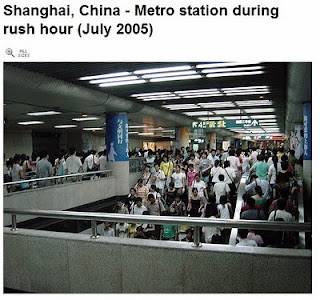
Overcrowded Metro trains in Delhi, Shanghai, Tokyo and London

Recently, there was an article that I read which mentioned that Shanghai Metro hired officials to ensure people stand in lines and use the Metro. I felt it could possibly be in Delhi Metro. I read the article twice and it turned out to be true that indeed it was Shanghai Metro.

I was shocked. I only could think of this in India. But Shanghai, Tokyo, Moscow, London are plagued with the same problem. Shanghai Metro Center INCREASED THE FREQUENCY OF TRAINS AND REDUCED WAITING TIME TO 3 MINUTES and YET THE OVERCROWDING DIDN'T STOP and SO INTRODUCED PARALLEL BUS SERVICE IN ORDER TO INTEGRATE..BUT THAT DIDN'T HELP BECAUSE VERY FEW GO TO BUSES.
Shanghai Metro experiences terrible crowd during 7 am - 9 am and it is quite obvious why (because everyone wants to head to their respective offices).  The article further mentioned that it is JUST 2 YEARS AGO THAT THE METRO STARTED OPENING ALL NEW LINES AND IT IS 70% OVERCROWDED AT PEAK TIMES and 30% OVERCROWDED ALL THE OTHER TIMES. THERE IS FREQUENT DELAY OF TRAINS BECAUSE DOORS WON'T CLOSE BECAUSE OF THE HEAVY CROWD.

Not sure, which country...but surely some country outside India and in South East Asia.


(Images Courtesy: LINK, Google images, skyscrapercity)
 SHANGHAI


Let's look at TOKYO

Let's Look at Tube (LONDON)


So, how about DELHI METRO?


This specially happens at RAJIV CHOWK (Connaught Place) because it is the main interchange lines. There are of course 2 more points which need to yet open and once open the overcrowding would stop here. If you closely monitor the newspaper cut out above, you will notice that Line 3 has 42 stations and 38 trains. After seeing an enormous crowd, the trains have now been increased from 38 to 45, but still RAJIV CHOWK is the busiest and most overcrowded station.

However, we have other problems as well as given below.


However, we need to understand that even if it is just a 10 minute ride, say, METRO would take us much faster than driving on the roads. It drastically reduces time even at the cost of the crowd.

So, it doesn't mean we don't need it. What needs to be ensured is that either a) increase the coaches from 6 to 10 per train b) Reduce the waiting time so that people are able to get one or the other train.

As it is, this is already being done in Shanghai, Tokyo and definitely to a certain extent in Delhi too.


I have personally experienced this crowd at RAJIV CHOWK, but trust me the ride is worth it than driving on the roads. One also needs to note that DELHI METRO has an extremely good air conditioning even in that type of crowd.

Today, the total DAILY ridership in Delhi Metro has crossed 9,00,000 mark, which is less compared to 20,00,000 of Mumbai local trains.

The only flip side is that security breaches are just bound to happen which is a serious concern.