Tuesday, March 13, 2012

Pics of New Indian highways and roads

This is my 5th article on Indian highways and roads. As the road expansion continues across the country, Gujarat and TamilNadu continue to have the best roads. While many states are catching up, there are several others not. While no city can boast of having planned and good roads we continue to struggle with bad or average roads. The biggest problem in city roads is not even the road anymore but the uncontrollable traffic that far exceeds the road capacity.

While the Golden Quadrilateral was completed a long time ago, the North-South-East-West Corridor is more than 80% complete. In addition to this several highways are being currently done across several cities. While we cannot feel good about our city roads our highways are good to drive on. Some stretches are unbelievable in cleanliness, maintenance and width. So, here I paste some pictures of the new highways or roads. These pictures are definitely different from my other articles.

While these new highways are far from perfect they are good to drive on long distances. It is a change that is very much visible.

Our expressways continue to slowly grow. We are now from 200km to 600km. The most awaited expressways are going very slow- Ganga Expressway, Pathankot Ajmer, Bangalore-Chennai 6 lane, Ahmedabad Vadodara Expressway. No one knows when these will get completed. The Land Acquisition Bill is still not passed and that is seriously hampering our highway growth. All the pros and cons I mentioned in my previous article still apply to the expanding roads.

PICS COURTESY: Skyscrapercity, Google Images

NORTH:

Srinagar Leh


Chandigarh-Kasauli:

Yamuna Expressway (not yet completely opened - expressway from Delhi-Agra. Right now it is badly congested on the main NH that is a part of Golden Quadrilateral)

Lucknow-Kanpur, Meerut
 Jhansi-Kanpur (NH-25)

WEST:

Rajasthan - Mt.Abu, Bharatpur, Gujarat-Rajasthan border, Udaipur


Gujarat - The best roads:
Halol-Godhra, Rajkot-Jamnagar

Ahmedabad-Mehsana

Maharashtra:

Pimpal-Dhule, Mumbai-Nashik


SOUTH


NH-4 near North Karnataka


Thrissur, Kerala


Kochi:

TamilNadu:

NH-45 (Chennai-Ulundarpettai,Perambalur)


AP - Hyderabad Ring Roa, Chittor roads


CENTER and EAST:

Maharashtra-Chattiagarh Border, Jharkhand-Dhanbad


Muzzarpur-Purnea, NH-31 going from Bihar to Assam


Madhya Pradesh:

Dewas_indore, Shivpuri-Jhansi


Assam:
The pace of road expansion must double as it is very low considering the rate at which the economy is growing. 

Tuesday, February 7, 2012

170 million enrolled, 120 million UID numbers issued...What next for UID?

This is my 3rd article on UID Project or AADHAR. The previous ones posted are here - Article1 and Article2

First, a dedicated work personnel of Unique Identification Project Team (UID Team) has issued 120 million unique numbers by collecting 10 finger prints, iris scans and basic information such as name, address, date of birth and some other demographic information. While the actual enrollment itself is 170 million, but of this 120 million numbers have been generated. Several banks and registrars have now advertised they need AADHAR number to qualify or confirm your identity. Beginning from districts in Maharashtra, Karnataka and Andhra - a lot of places have been covered. The UID camps continue to be set up, advertisements published and generate the letter and sent to beneficiary. Any time anyone submits AADHAR number to a bank and the banks connect to UID server the information that it gets back is you are found in the database and if it is same as you. There is nothing more that UID will send you back.

Second, let us congratulate the team to complete a mammoth 170 million. We have a long way to go to reach 1.2 billion but the rate at which the enrollments are being done it should be a matter of 4 years or so. 

However, at one point this whole project was under the threat of extinction. This was mainly because UID's clash with the Home Ministry's ambitious project of National Population Register (NPR). The NPR is the largest database of all people living in India and the main task that feeds data into NPR is the Census data. Earlier, there was a clash between the two and both were doing duplication task of biometric data collection. Why would any citizen or resident submit bio metric data to 2 different agencies? It is inconvenience. This had led to the tussle and finally it has been sorted out.

The people who have given biometric information to UID will no longer have to give to NPR. But those who have not given bio metric information to UID will have to do so for NPR. This would prevent duplication and if there is any it will lead to de-duplication. Well, the solution sounds good, but the question remains - Why would NPR now collect bio metrics and not UID? It is believed that in a case UID fails to detect the person's identity NPR is the sole or superseding database that will tell if that person's data is found or not. If NPR fails and UID succeeds then NPR will prevail. Does this make sense? It does not.

But why did all this confusion start? Is UID compulsory or submitting details to NPR?

Actually according to the Citizenship Act 2003 which was made in 2003 stated that it is compulsory that every Indian must go and register with NPR - "As per Rule 7(3) in the 2003 Rules, “It shall be the responsibility of every citizen to register once with the Local Registrar of Citizen Registration and to provide correct individual particulars.” Source

At that time the concept of UID Authority was not even created. It was assumed that the NPR data would generate the Identity Number. No mention of bio metric data was done. It was in 2005-06 that the idea of bio metric data was initiated and part of the NPR's job was given to UID Authority but limited to only 200 million. Now that the enrollments reached the figure and the budget has gone ten times high the Home Ministry began to question it. It looks like P.Chidambaram wanted the Home Ministry to supersede and control everything. 

Now, it has been made clear that you may or may not want UID number but you need to compulsorily give data to NPR. The biometric collection agencies are common to both NPR and UID which is good. In the long run however everyone will ask for UID number and the Home Ministry will have to include UID Number into NPR. This will happen. 

Should this project then continue? YES

Many people criticize this project. There are lot of concerns about privacy. However, only when the database is set up can the privacy laws be established. It is hard in a country like ours where the rule is set up first and the project started. We should reach 500 million mark soon. Once the NPR and UIDAI finish their job the legislation has to be introduced and the powers and limits be discussed. For now, UID will only tell you - "Who you are is what you claim to be" and nothing more. 

The major challenges that this project is facing are just visible. As this report by Usha Ramanathan published in the Frontline news magazine highlights it is very shocking to see the pitfalls in the system. For more can be read here, I paste some of them

In May, “unidentified persons” walked away with two laptops and a pen drive which held data pertaining to 140 persons from an enrolment centre in a school in Hadaspur, Maharashtra

In July, five persons were arrested in Bangalore for issuing fake UIDs. The UIDAI heard about the racket when they were approached with complaints that “Global ID Solutions” was selling franchises to customers to take up Aadhaar enrolment for a non-refundable fee of Rs.2.5 lakh an enrolment kit

In October, a software error resulted in hundreds of residents of Colaba in south Mumbai having their addresses recorded as Kolaba, Raigarh district.

Such events only make one lose confidence in the team and question the government's commitment level to this ambitious undertaking. 

Watch this video on youtube and you will be shocked that corruption has reached even this undertaking in cases where person who has nothing (no document whatsoever) is to be included into the system via an Introducer.


An excellent video was the reality report on this project on NDTV. This must be watched by everyone. The video clearly explains how difficult it is to enroll people who do not have any documents about themselves. The percentage of such people and such peoples' data being recorded with wrong proofs or introducers is getting higher. How will this system work transparently? It is a major challenge and seems to be that no one has talked about solving it.


However, any major change has issues and problems, but it should not be stopped. There are several people who even could not open a bank account are now able to do so because of AADHAR. Reserve Bank of India now legally accepts AADHAR for opening a bank account anywhere in India.

Unique Id project is truly a revolutionary undertaking and must continue despite criticisms and all pitfalls.


Monday, December 26, 2011

FDI in Retail: Will it help the economy?

If one has read my last article, it would be clear that the UPA Govt has not passed a single legislation this year that can help the economy nor has it shown any interest. All of a sudden when rupee began to reach 53 against dollar the fear began in the government. Depletion of dollars and no major reform eroded the growth projection to less than 7% and decreased the confidence of India in the eyes of the world. It was a desperate attempt to inject dollars and hence in between the Winter Session the Govt decided to clear FDI in single brand to 100%. It had to finally backtrack after the entire opposition including its own allies protested against this.

FDI in retail is a huge legislation as its impact can be felt across farmers and traders which are the biggest vote banks for Congress and BJP respectively. But does FDI in retail help the economy? Does it help the farmer? Does it help to control inflation?

The answers for this can be understood if the existing scenario with facts are presented. Let's look at it.
  • 60% of what farmers produce gets consumed in villages (over 6 lakh villages).
  • 40% makes it to the market for everyone else to consume.
  • The current Agriculture Produce Marketing Act (APMC) prohibits farmers to sell to anybody who doesn't have APMC license. There are exceptions to this in several states notably Punjab and Gujarat.
  • 40% of this 40% that reaches the market gets wasted as there is no storage facility at the APMC yard nor does the govt has ever bothered to set up cold storage facilities in proportion to what is produced. It has set up in some places, but not adequate for all fruits and vegetables.
  • 40 million people get employment because of the existing unorganized retail or mom-pop stores. 200 million people lives depend on this 40 million. (Source)
The amount of wastage in 2011:

So, how does this 40% reach the consumer?

There are anywhere 6-7 layers between a farmer and a consumer(follow the chart below). The farmers go to village Haats, Shandies etc that are setup on a regular basis (daily, weekly or bi-weekly) and are either held at the village or 6-20 km from the village. So, the farmer travels. The farmer also goes to APMC yards where there are government agents and middlemen (commission agents) who purchase from the farmers and pass on to wholesale dealers, retailers and thereby consumers. Each layer adds a price and hence the consumer ends up paying a huge price and the farmer gets only a portion of it as profit. The rest is eaten up by the middlemen.


Hence, farmer sells say potato at Rs.2 per kg while consumer buys at Rs.12 per kg which means Rs.10 is eaten up by middle men. Neither there is regulation nor control on the prices or the profits the middlemen make. This is one of the major reasons of high inflation in India. I had explained this in my earlier article - Why onion prices have skyrocketed? .

Further, farmers don't get the correct price and the weights are not accurate as well.

EXCESS WASTAGE, INFLATION CAUSED DUE TO MULTIPLE LAYERS and NO PROFIT FOR FARMERS - clearly 3 major problems in the existing model.

The current organized retail stores in India (prominent ones):

Big Bazaar, Spencers, etc constitute only 5% of organized retail while the unorganized retail is still 95%. Each of these stores may look like they are making profits, but their losses run into thousands of crores. (Source: http://www.ndtv.com/video/player/truth-vs-hype/the-truth-vs-hype-of-big-retail/218151)

Will the entry of foreign players help the current scene? If yes, how?

Again, looking at the chart which showed 6-7 layers in the existing model between a farmer and a consumer, the entry of foreign players will reduce it to 3-4 layers, a cut down of 3 layers in most cases.

The foreign players like Walmart, Carefour, Tesco have huge presence across the world. They have the expertise to manage such huge distribution issues and have applied technology to the fullest extent. When such players come in they will directly deal with farmers and get the produce from them. They would ensure that farmers are given better price, weights are checked properly and storage facilities set up for excess quantity to prevent wastage. Basically transparency sets in.

To maintain any cold storage facility is not a rocket science. However, for 60 years no Govt or any law has accelerated this process. Yes, these storage facilities require electricity, water but that's precisely what Govt has spelled out that 50% of investment that such companies would make must be in this sort of back end infrastructure. In other words what Government could not do these companies are expected to do!!

As an example, look at how Walmart has opened stores in Punjab and how it is helping them get better prices and ensure transparency in the system. This is not to say Walmart is sincere in what it does and our middle men and small stores are not. It's just there are many practices which such stores have which others do not. Such an expertise is needed to propel competition in this sector ultimately benefiting the customer. In Punjab today Walmart has tied up with farmers on contract farming basis and such stores not only regularly take the harvest/produce from farmers, but ensure a clean mechanism of making payments. They don't have to travel much as Walmart has set up a network of centers to do this collection.  The farmers are also trained on how to increase the yield and productivity that helps them and Walmart. Here's more to read on this.

These are the pictures of Walmart store in India. As of today 100% FDI in single brand is not allowed and hence Walmart has tied up with Bharti and called it - "Best Price Modern Wholesale".


A single store hires 35,000 and has changed the way the whole supply chain system works there. Think of this - If one store can employ 35,000 and if Walmart can open 10 such stores they would employ a mammoth 3,50,000 people and train them with better customer friendly practices and update them with technology. How many small stores can create such a huge employment at the same time? In today's world the next generation doesn't want to join their parents' business of mom and pop stores. Think of what opportunities such stores can have if they could tie up with such multi giants to supply their products as is happening in Punjab?

In short - EXCESS WASTAGE IS AVOIDED, BETTER PRICES ARE GIVEN TO FARMERS and SMALL STORES BENEFIT FROM TIE UP WITH SUCH GIANTS:

Can FDI in retail help control inflation? Will prices come down?

This is definitely a grey area. It has mixed shades. Take a look at this video here. According to this, the 5% organized retail which exists in India haven't helped much in bringing prices down. In many cases prices at such stores are more than the ordinary retail store (Source). So, will inflation be able to come down? 

The fact we have to consider here is that 5% doesn't bring competition but 20-30% will surely do. Presence of multiple stores will propel competition. If Hyundai and Maruti alone were the cars in India there would not have been lower prices. If Airtel and Spice were the only cellular service providers prices of calls would not have come down. Presence of different companies spurs competition. One could not think of buying any other car for the range Rs 4-5 lakh a few years ago other than Maruti. Now, there are several cars to choose from for that range. Similarly, a handful of stores being a part of organized retail doesn't help.

On the other hand a logical thought that comes to one's mind is how could these stores sell at a lower price when their operating costs are so high - rent, electricity, water, labor charges etc. Many stores actually got closed like Subiksha as they did not have the expertise of the back end. Big Bazaar, Spencers are all incurring operating losses. So, will multiple stores help? We cannot definitely say. That is why this area is a shady area with no clear visible impact in India. Hence this must be done on an experimental basis.

The government has this condition that such stores must be set up in cities with population more than 1 million and currently there are 51 cities in India that satisfy this condition. This has to be experimented. Only then can it be determined if inflation can truly be controlled. Contrary to the claims of both who oppose this legislation and those who want it to be enacted have no proof of all that they claim regarding inflation is indeed true.

Can foreign companies dump goods from different parts of the world? If so, what about - Made In India - products?

As it is many customers today get to see products from different countries. So, this is not new. However, Walmart for example gets 80-90% of its goods from China. China is the biggest beneficiary. If these stores are allowed to operate in India they will surely dump them into our markets. No doubt the consumer benefits, but goods and products made in India will not reach the consumer. Hence, the government has put the condition that 30% of products such stores would sell in India must be from Indian suppliers. This is good, but must be increased to 40%. By doing so, such stores can also get an opportunity to sell goods made here to other countries and make additional profits. Who knows tomorrow Indian mangoes may be available in America in Walmart and become dominant there? 

This is a very important clause and must be carefully implemented. There might be a need for a regulator to monitor if the stores are indeed sourcing 30% from Indian counterparts. If the stores do not take this seriously it will cause losses to a lot of small stores who would have dreams of tying up with them. This is definitely a genuine concern for retailers.

Will the small stores eventually shut? No, this is an exaggerated fear

How many stores have closed because of Big Bazaar and Pantaloon? Hardly any. In fact the unorganized retail continues to show 15% growth while organized retail has come down from 25% to 15% in the last few years. Why is this so? This is because a consumer would prefer to go to stores at a walking distance even if the cost is Rs.1 more than a store for which he has to travel a small distance. Most housewives cannot depend on their husbands or use transportation to get small items. They would prefer to go to near by stores. It is this particular attribute of Indian retail mindset that still keeps the small stores going. There are other personalized services these stores may offer. In many places they offer door-to-door delivery, deferred payments, cash payments accepted and many more which the big stores may not offer. Simply because it doesn't work out to them. Since Big Bazaar cannot come up in every street it cannot displace the small retailers. It may hit their profits but cannot shut them down. If it had to then it would have been visible by now.

The real estate prices are too high for such giant stores to be set up everywhere. Hence, they must be allowed to change the whole supply chain and bring in clean and efficient mechanisms.

This chart explains how FDI in different countries has helped them and why the govt's idea of India specific model is actually good.


Images courtesy: Source

In conclusion I feel FDI must be allowed in cities to start with and depending on how it would control inflation and farmers should be applied across the country. For whatever reasons BJP is opposing looks wholly opportunistic. Congress at one point too opposed this. It is not too late when this would become a reality. For sure FDI in retail will come about.

Sunday, November 27, 2011

The Govt stagnates the growing Indian economy

The year 2011 has been the worst year for India as far as policy initiatives, policy implementations and legislations are concerned. Not a single piece of reform has been taken up by the Govt. From the beginning till the end other than the discussion on the Lokpal, Govt did not do anything substantial on reforms. It has been just sleeping. 

If recession plagues the West, inflation plagues India. Inflation is a sign of economic growth, but excessive inflation is a sign of huge mismanagement of the economy.

The Indian economy has clearly slowed down. The growth levels have been reduced from 9% to less than 7%. High inflation, high interest rates (auto, personal, credit, home and virtually everything), low growth and lower industrial growth has now taken the sheen of the India growth story. 

The rupee has gone to new record levels of close to Rs.53 against the dollar. This is a new record. This appreciation means imports will get costlier. The oil prices will rise and adding to the RBI's interest rate hike the inflation will go northwards without a stop. The government doesn't want to take any step. The Govt has not even passed many of the bills which can usher in new economic spurt such as Companies Bill, Direct Tax Reforms, Land Acquisition Act, FDI in aviation, The Seeds Act and many more.

For one year other than just talking nothing has the PM nor the Congress party done anything new in the economy. The thought probably is India is rising and there is no need to act. This is a colossal mistake.

Let's take some numbers. Industrial growth has slowed to <2% this year. No major projects, proposed projects have been getting delayed due to the same reasons like Land issues and delayed environmental clearances. Clearly, the Govt has not defined new rules under which Land can be acquired for any project and if acquired what sort of compensation will it give to farmers. How long will the govt take to bring in that bill? Rahul Gandhi has been shouting for this bill to make political gains over Mayawati, but has not been bothered to push through that bill to make it to the Parliament to discuss it. 

Car sales have slowed down, investment in real estate has slowed down. The amount of dollars that flooded the Indian market in 2009 has clearly reduced to drastic levels. The result is the rupee falling to Rs.53. The compounding crisis of the Europe has also hurt our exports(both goods and services). Neither the Govt nor the RBI have any tools to control this. The only way the govt can bring in the dollars is to increase the confidence in the Indian economy by passing some key legislations like the ones mentioned earlier.

Of 183 countries in the world, India ranks 165th for starting a new business - mainly because of complex rules and red tapism. The new Companies bill drafted by the Govt has to be pushed through the Parliament.

India's electricity and energy sector continues to pose significant problems for the growing industry. No major initiative has been done to drastically improve this sector either.

Looks like the Congress Govt has become lazy, incompetent and over confident. Their over confidence may be that no matter what happens they will continue to be in power. I am alarmingly shocked that when many European nations have had regime changes and new technocrats rather than politicians have taken center stage, our very own technocrat PM Singh lacks political will to bring in changes. His relevance as a technocrat stands completely hollow now. I don't know how many in India think that life has gotten any better ever since the second time PM has been voted back in 2009. It was a golden opportunity that India missed now that the US and Europe's economies have declined.

The time has come to take action. The govt said it has cleared FDI in retail to flood the market with dollars again to counter the depletion and the deterioration of the Indian rupee and economy. There are almost 40 key legislations and none seems to be passing this Parliament session. The opposition party BJP must shout slogans or raise the level of the debate in Parliament but should not stall the passage of many of these bills.

Indian growth story can continue only when the government can take tough policy decisions. Now that the economies of the West are in the dark, it presents a golden opportunity for India to shine. This only can happen if the government wakes up from the sleep.

Friday, October 21, 2011

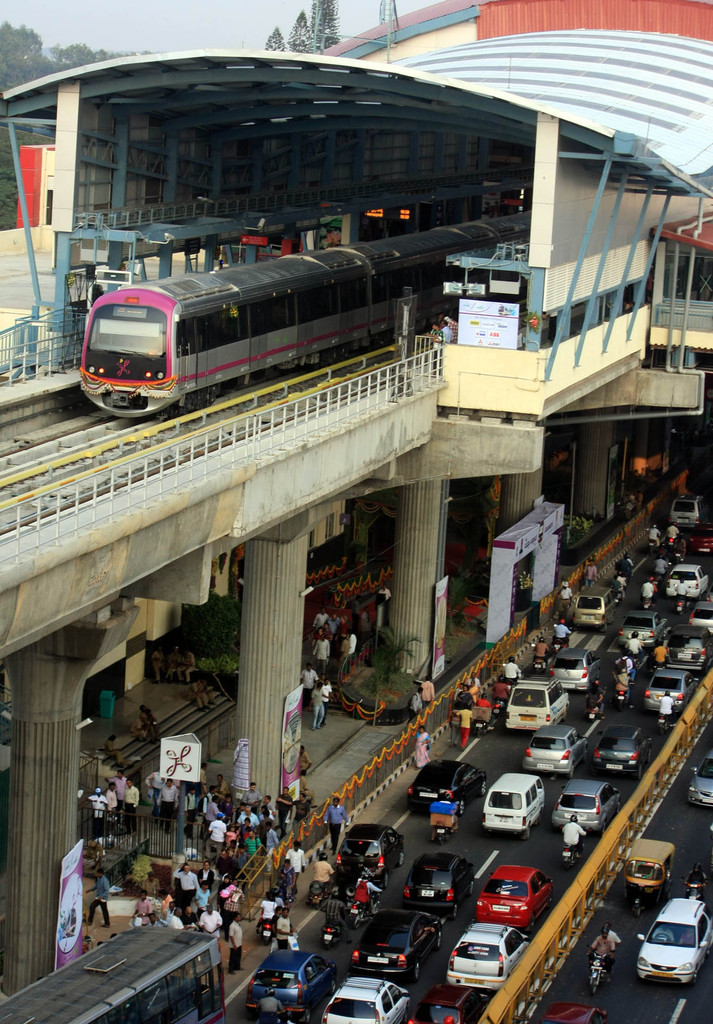
Reach 1 of Bangalore Metro rolls out

Bangalore for long had wanted the Metro. It started smoothly and later went on a rough patch. With 3 deadlines finally passed reach -1 of Phase-1 was opened for public on Oct 20th 2011. It is 3rd in the country to have a system of this kind and on par with international standards as far as tracks, coaches, signalling is concerned. The excitement that was visible when Delhi metro first started was similarly visible even in Bangalore. I still remember when I boarded the first metro of Delhi - the red line - I was wondering if I was indeed in India !!!

Bangalore Metro is South India's first metro. This has made the people of Chennai, Mumbai and Hyderabad even more restless and are eagerly waiting for their own metros to be completed.

If the excitement and the way people thronged the stations is an indication of anything then it is the rising expectations of the people who are desperate to see how the other parts of the Metro completely finish without missing deadlines.


The stops, the frequency, timings are given below:

The fares are as below:

However, some of the salient features include:


  • Improved sign boards and clear display of information at the station and inside the train.


Flip side:

Train frequency is 15 min (it will be reduced eventually depending upon the demand)
Metro will not reduce traffic congestion drastically (may be 10-20% reduction) and it is too much to expect that given the fact that Delhi, London, Tokyo continue to experience traffic issues and overcrowded trains
At least until the metro is completely over one cannot expect any changes.


Pic courtesy" skyscrapercity, google, youtube, timesofIndia
Feeder buses:
The places where feeder buses serve is in the chart below:


There are lots of questions which can be answered slowly over time. Will Metro be maintained clean? Will there be sufficient patrol of it like in the Delhi Metro? How frequently will the train develop technical snags? Will the escalators work all the time and if it needs maintenance how quickly will be repaired? Will the feeder buses which pick up and drop to nearby areas work correctly and effectively?

Sunday, September 18, 2011

Modi v/s Rahul: Who would win?

It is 2011 and 2014 is 3 years away. In 3 years one never knows where the 2 parties - Congress and BJP would be? As of now, everyone thinks Congress will fail. Congress is too clever at political strategies before the election. They can throw surprises by announcing schemes, or programmes that will make them the hero of the media and the poor. One of the legislation - National Food Security Bill (though has several loop holes) can be Congress's trump card against corruption. It is another matter that this bill will cause incomparable increases in inflation causing further damage to Indian economy. 

3 years down the lane -  the media, the aam aadmi may forget all the movement led by Anna Hazare. Media  may project Congress as the only party to launch such a scheme that will bring down poverty in a single shot. People may forget all the corruption and scandals and think that Congress is still the savior. People may think that both BJP and the Congress stand the same with respect to corruption, but still support the Congress.

At present, why this issue of Modi v/s Rahul? It is very hilarious that a US report conducted by its think tank can cause such a reverberation in India. Modi's announcement of his Sadbhavana mission is being stretched too far by everyone. Neither BJP has projected Modi as its PM candidate and nor has Congress projected Rahul as its PM candidate. Still everyone is speculating that this will be the reality.

Modi:

The ghost of 2002 never seems to leave Modi. The Supreme court has not found any strong evidence to file even an FIR against him, but it has some strong words for him. Still it has decided to hand over the case to courts in Gujarat. No one knows what the verdict would be. If the High Court proves him guilty, he is bound to have immense losses, but if not he will win handsomely.

If Modi indeed is proven guilty he will have to be punished and there can be no doubt about it. What I admire about Modi is not his character, but his governance. I have a series of articles collected from various national, international media and case studies from IIM Ahmedabad under Modi's governance in my blog.
More than anything else, read this report published by the US which states Gujarat is the best governed state in India followed by Bihar. One can never deny that Modi's rule has given the maximum progress to Gujarat that it leads far ahead than all states in India since 2004. Some people claim Gujarat is progressing for the rich. If that is the case, can anyone explain how is agriculture growing at 10% when the entire national average is 3%? Who is using the 1000 check dams constructed by the govt in Saurashtra (a drought prone zone a decade ago that is now fertile)? Who is benefiting from 24 hour electrification of more than 90% villages that have transformed the lives of farmers? No state has been able to achieve this - states ruled both ruled by BJP and Congress. Just look at the roads that exist in Gujarat. Gujarat is one of the only states in the country where ports are well connected to major cities in the state that has boosted maritime trade.

Some people including the Congress in Gujarat claims that doing business is in the DNA of the Gujarati and so Narendra Modi has not anything much. If that is the case then Gujarat must have been the number 1 state in India since 1947. There should not have been any poverty in the state. There should have been only rich people. No state can achieve progress without the government facilitating an atmosphere where businesses can thrive and farmers can progress. 

No one can forget what happened in 2002 and no one can ever let injustice happen to anyone. People often forget that Modi has been re-elected twice by the people. He has not become the CM through a military coup but through a free and fair election.

Some people have called 2002 riots a holocaust. Every communal riot is a holocaust. Even those which occurred during the Congress rule (This was in 60's and  70's when BJP did not even exist) . 

Rahul:

I frankly admit that if Rajiv Gandhi was alive today and stood for elections, I would have really wished him become the PM again. Manmohan Singh is far far better than Rahul Gandhi. Manmohan Singh may not take decisions at the right time, but he has a statesmanship approach when he wants to talk to his worst detractors. When the entire nation rose in support of Shri Anna Hazare (my hero these days), I expected Rahul Gandhi at least to come out and say that he would convince his party and the government that the voice of the youth will be heard and Anna Hazare's peaceful protest shall be respected. Where was Rahul Gandhi when Kapil Sibal and P.Chidambaram decided to arrest Anna? Where was Rahul Gandhi when the entire Parliament was discussing the issue of Lok pal bill? I salute Pranab Mukherjee who stole the show from the Congress side in Parliament. An old Pranab was far capable and convincing than a young Rahul who was absent. My biggest problem with Rahul is that when the time arose that India needed leadership from the side of the Congress he let everyone down.

The Reality: Congress still has a higher chance of winning in 2014 than the BJP. 

The big strategy which BJP has to adopt is not to declare anyone as its PM candidate (more so that of Modi). This was the same strategy which Congress adopted in 2004.

Let's not forget that Congress still has a presence in almost every state unlike the BJP. If Modi is projected as the PM candidate, the chances are that several allies may desert the BJP because of a fear of loss of vote banks. In that situation BJP has to win around 200 seats on their own which seems highly impossible. So either way it is a tough road ahead for the main opposition party if it projects Mr. Modi as the PM.

People are the ultimate deciders of the 2014 election, but people must exercise enormous caution specially now that India is one of the rising economic powers of the world. The challenges and complexities are high and we need a leader who has proven something and not just talked. We need a leader who can rise to the occasion and take tough measures and decisions to take the entire society on the path  of growth. We cannot be slow and steady, but fast and tough.